The Single Shared Memory Myth
The single shared memory myth hides disagreement and change. See how layered, contested and revisable public memories help communities speak more honestly.
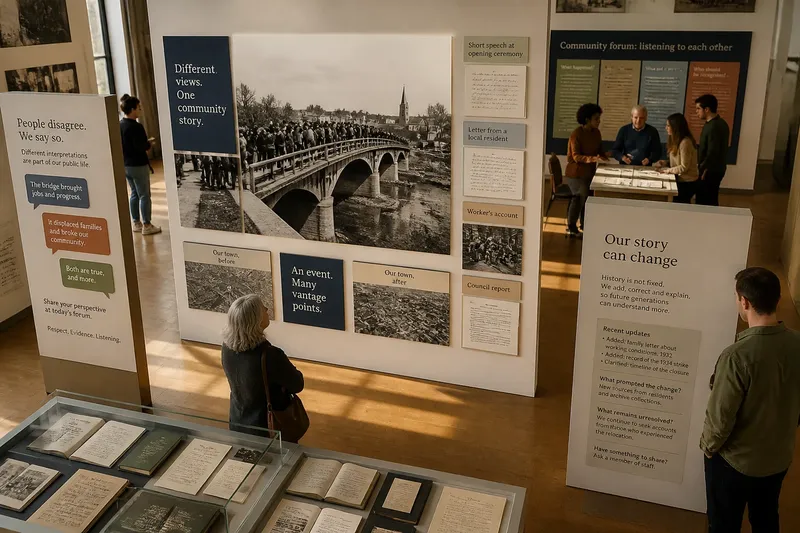
At a town-hall display, one photograph shows a crowd gathered around a new bridge. A caption calls it “the day the town came together”; a visitor recognises the scene as the day her family’s homes were cleared to make way for it. Public memory rarely sits in a single frame. The single shared memory myth turns one version into the community’s supposed common inheritance, leaving other experiences outside the caption.
A more useful question is not whether everyone remembers an event alike, but how a community makes room for what differs. Public memory can be layered, openly contested or deliberately revisable. Each approach offers a different way to organise shared accounts, and each suits a different moment.
Layered memory
A layered approach keeps several accounts visible without forcing them into one verdict. A display might place a civic leader’s speech beside residents’ letters, a workers’ account beside an official report, or a map of a site before and after its transformation. The aim is not to claim every account is identical in weight or evidence; it is to show that an event had more than one human vantage point.
This approach suits a community that wants visitors to understand complexity without turning every public space into a debate. It works particularly well in museums, libraries and local archives, where documents can be arranged with context. A short note can explain who produced a source, what it records and what it leaves unclear.
Layering has a risk: a neat row of perspectives can suggest that every account is equally supported or that merely displaying disagreement resolves it. Editors should distinguish between documented claims, personal recollections and unanswered questions. The arrangement itself also matters: placing a testimony in small print beneath an official statement can quietly restore the hierarchy the display claims to question.
Contested memory
A contested approach makes disagreement part of the public account. Rather than smoothing conflicting interpretations into a shared message, it names the dispute: people may disagree about what an event meant, whose actions deserve recognition, or whether a public tribute still represents the community. The disagreement becomes visible, not as a spectacle, but as a fact about civic life.
This suits issues that remain emotionally or politically live, especially when a permanent, unanimous-sounding statement would erase meaningful objections. A council discussion, a public exhibition with multiple interpretive panels, or a moderated community forum can make space for competing claims. Clear ground rules help keep discussion focused on the subject and its consequences rather than on attacking other participants.
Contestation is not an excuse to treat every assertion as equally credible. A public account can identify the evidence behind claims and distinguish documented events from disputed interpretations. Nor must every venue host an argument: a quiet memorial may serve mourners better than an invitation to debate at its threshold. The format should fit the place and the people who use it.
Revisable memory
A revisable approach treats public interpretation as work that can change. Plaques, museum labels and local history pages need not pretend that their first wording is final. A community can add new sources, correct an omission or explain why an earlier description no longer serves its purpose, while preserving a record of what changed.
This suits institutions with continuing responsibility for a site or collection, and communities whose understanding is developing as records surface or residents contribute accounts. Revision does not mean swapping one polished story for another. It means making the editorial choices legible: what was changed, what prompted the change and what remains unresolved.
For instance, imagine a library’s wall label describes a former factory only as a source of local pride. A resident brings a family letter describing dangerous work and an official archive holds a record of a strike. The library could add those sources, explain their relationship to the original wording and invite further material; visitors would then see both the change in the account and the evidence behind it.
Choosing a memory approach
Choose according to the task, not the wish for a frictionless story. A display intended to introduce a complex event may need layered accounts; a live dispute may call for explicit contestation; an enduring public record may need a clear route for revision. Some projects can combine these approaches, but they should say which purpose leads.
- Start with the venue. Ask whether visitors are there to learn, mourn, deliberate or consult records. A memorial, a council chamber and a local archive invite different kinds of attention.
- Identify whose account is missing. Look beyond official speeches and established collections. Consider residents, workers, displaced people and those whose contributions were recorded informally.
- Separate evidence from interpretation. Label documents and recollections clearly, and explain where sources agree, differ or fall silent.
- Choose the right degree of openness. Use layered presentation when context is the main need, explicit disagreement when conflict itself matters, and revision procedures when the account must remain updateable.
- Set an editorial responsibility. Name who will review contributions, handle corrections and explain decisions. An open invitation without a responsible steward can leave contributors unsure what happens next.
- Make change visible. Keep an accessible note of meaningful edits so that revision adds context rather than quietly erasing the earlier account.
Questions about memory?
Does shared memory mean everyone agrees?
No. People can recognise the same event as part of their community’s past while disagreeing about its causes, consequences or meaning. A shared public account can acknowledge that difference instead of treating agreement as a test of belonging.
How can omissions be addressed?
First identify which voices, records or experiences are absent, then explain what is known and what remains uncertain. Invite material through a clear process and describe how it will be assessed and presented.
When should a public account change?
Consider revision when new evidence matters, wording conceals a significant part of the story, or the account no longer reflects the institution’s stated purpose. Explain the reason and retain a record of substantial changes.
Can a memorial stay quiet and still be honest?
Yes. A memorial need not host a public argument to acknowledge that its meaning is not universal. A discreet accompanying text or a linked archive can provide context without changing the space’s primary use.
Belonging without sameness
The single shared memory myth can make belonging sound like agreement with an approved account. A stronger civic memory lets people recognise a common past while naming the uneven experiences within it. That does not remove disagreement; it gives disagreement a place in the record.
When deciding how to present public memory, ask what visitors should be able to see that a single polished story would hide. Then choose a layered, contested or revisable approach that makes that detail legible. The result may be less tidy, but it can offer a more truthful way to belong together without remembering in one voice.