The Work a Civic Motto Is Asked to Do
A civic motto can frame public identity without speaking for everyone. Learn how to read its wording, setting and limits with care.
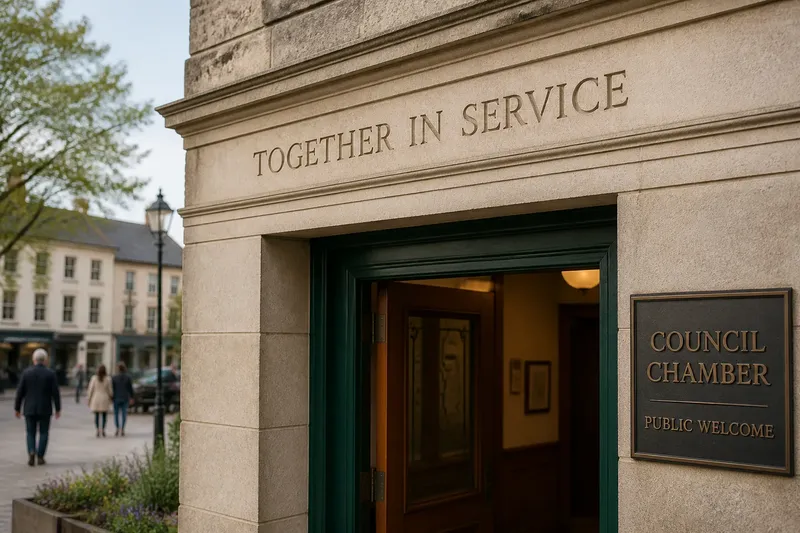
At a council meeting, a short phrase above the chamber door can catch the eye before the agenda does. A civic motto may appear on a town website, a school sign or a letter from the mayor, carrying an invitation to belong in just a few words. To understand what a civic motto is asked to do, start with the phrase itself, then look at who uses it, where it appears and whose experience it leaves unstated.
Read the wording closely
Write the motto down exactly as it appears, including any punctuation, capital letters or translation alongside it. Then ask what its main words mean in ordinary speech. Words such as “unity”, “freedom”, “service” and “welcome” can sound plain, but each points towards a different picture of public life.
Notice whether the phrase names a value, a place, a shared action or an aspiration. “A city of welcome” describes an ideal; “Together in service” implies something residents are expected to do. An imperative such as “Keep the river clean” sounds more like an instruction than a claim about civic identity.
Pay attention to what the wording leaves open. “We belong” might refer to residents, citizens, a particular generation or anyone who regards the place as home. The phrase may gain warmth from that openness, but its reach should not be mistaken for a precise account of who feels included.
Try paraphrasing the motto in a sentence without its ceremonial tone. If the paraphrase changes its meaning substantially, the phrase may be working through ambiguity or emotion rather than conveying a specific policy. Neither quality is automatically a flaw; the point is to see what kind of work the words can reasonably carry.
Find its setting
A motto does not speak in isolation. Check where it appears and who placed it there: on a council crest, a public notice, a school prospectus or a campaign leaflet. A phrase in an official seal can sound like an enduring civic claim, while the same words on a temporary banner may read as a particular event’s invitation.
Look for the accompanying material. A motto beside a translation, a short explanation or a named civic body gives readers more clues about how it is being presented. A phrase printed alone may invite people to supply their own meanings, which can make it adaptable but also obscure disagreement about what it implies.
Then consider the moment in which it is used. A welcome message to new residents, a speech at a public meeting and a condolence notice do not ask a phrase to do the same job. In one setting it may offer a reassuring ideal; in another, it may feel too cheerful or too broad for the circumstances.
Ask whether the motto is being used descriptively or aspirationally. “We are a welcoming town” sounds like a statement about present experience. “Let us build a welcoming town” signals work still to be done. Confusing the two can turn an ambition into a claim that residents are expected to accept as already true.
Trace who speaks
Find out which body adopted or uses the motto, without assuming that its authority makes it the voice of every resident. A council can speak for an institution in a formal capacity. It cannot make a short phrase a record of every person’s feelings, history or political view.
Check the route by which the wording entered public use. Was it chosen by an elected body, proposed in a public consultation, inherited from an earlier administration or introduced by a school or community organisation? The process does not settle whether a phrase is meaningful, but it helps clarify whose judgement it represents.
Notice who is addressed. A motto that says “our home” may speak differently to someone born locally, someone who has recently moved there and someone whose family was displaced from the area. The wording may welcome all of them, but it does not erase the distinct relationships each person has with the place.
Imagine a borough adopts “Many voices, one home” for its public notices. A resident who has just moved there may hear an invitation; another, whose neighbourhood has been overlooked in council decisions, may hear a promise that has not yet matched their experience. The phrase can still be useful, but only if officials treat it as a statement of intent rather than proof that every voice already feels heard.
Test the public claim
Now compare the motto with the institution’s practical language. Read a council service page, a public meeting notice or a letter explaining a decision. Does the phrase’s ideal appear in the way people are addressed, the languages offered or the routes for raising concerns? A motto cannot answer these questions, but the contrast can show whether its public role is symbolic, practical or both.
Look for a gap between the phrase and the experience it seems to promise. If a motto speaks of welcome, for instance, consider whether public information explains how newcomers can take part. If it speaks of shared responsibility, see whether it names the institutions as well as residents. This is not a demand that a slogan solve civic problems; it is a way to distinguish aspiration from evidence of action.
Keep the judgement proportionate. One awkward sign does not explain an entire community, and one polished motto does not demonstrate broad agreement. Treat the phrase as an entry point for questions about public identity, not as a verdict on whether a place has achieved the value it names.
What can a motto say?
Can a civic motto represent everyone?
It can offer a shared point of reference, but no short phrase can capture the full range of views in a community. Read it as an institutional expression or an invitation, not as evidence that every resident agrees with it.
What is the difference between a motto and a slogan?
A civic motto is commonly presented as a lasting phrase associated with a place or public institution; a slogan may be tied to a campaign or a specific appeal. The boundary can blur, so the setting and the body using the words matter more than the label alone.
Why do civic mottos use broad words?
Broad terms can let people with different lives recognise a value without requiring identical interpretations. They can also hide disagreement, so it helps to ask what the phrase means in the setting where it appears and who is expected to act on it.
How should a resident respond to a motto they reject?
Identify what part feels untrue or excluding, then connect that concern to the phrase’s wording, use or public effects. A precise objection gives a council, school or community group something clearer to address than a general declaration that the motto is wrong.
Choose a careful response
If the phrase seems meaningful, explain what it offers without claiming it speaks for all. You might say that it expresses an aspiration, marks an institutional identity or gives residents a phrase they can interpret in different ways. Naming the limit makes the explanation more credible, not less.
If the motto feels inaccurate, ask a concrete question: who selected it, what does the institution mean by a key word, or how can residents raise a concern about its use? A focused question can open a discussion about public language without demanding that everyone share one account of belonging.
If you are writing about the motto, quote the words accurately and identify the setting. Separate what the phrase says from what an official says it means, and distinguish both from your own reading. That simple separation helps readers see where interpretation begins.
A civic motto can be a compact invitation, a statement of aspiration or a marker of institutional identity. Reading it well means holding its words beside their setting and their limits. The next time you encounter one on a town-hall doorway or a council page, ask not only what it declares, but what conversation its shortness leaves for the community to continue.